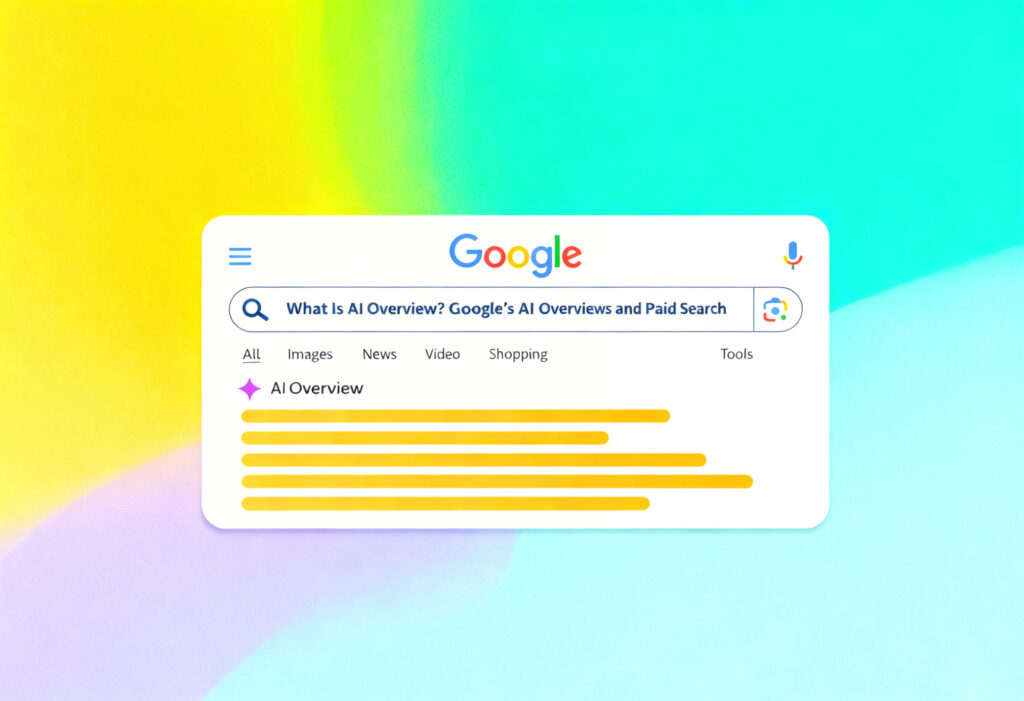

If you’ve Googled something recently and noticed a block of summarised information at the top of the results, you’ve seen Google’s AI Overview in action. It’s part of a bigger shift in SEO and how search engines deliver answers, pulling from multiple websites to create a quick, consolidated summary.
So, what does AI Overview mean for your website and content marketing strategy? And more importantly, how do you show up in it?
This guide walks through how to rank in AI overviews by creating SEO content that’s genuinely helpful, technically sound and aligned with how Google understands and presents information through AI.
Let’s start with the basics.
What is AI Overview on Google?
Google’s AI Overview is a feature that uses generative AI to summarise responses to search queries. Instead of just showing a list of individual links, it delivers a snapshot answer. This is often paraphrased or quoted from several websites, sometimes with links and sometimes without.
If you’re wondering what AI Overview actually does, it’s designed to offer users a fast, informative response by distilling information from trusted sources. This makes it a new and exciting addition to the world of SEO.
So, how do you get an AI Overview?
How to Rank in AI Overviews: Start with Intent
Ranking in an AI Overview isn’t about keyword stuffing or tricks. It’s about making sure your content provides the searcher with the most helpful answer.
To give your content the best chance of being picked up by AI, your SEO content marketing strategy needs to work with the way search is evolving. Here’s how.
1. Focus on Search Intent and Semantic SEO
Every search starts with a question in someone’s mind. It might be “what does this mean?” or “how do I do this?” The closer your content gets to answering that exact question, the more useful it becomes, and it makes your content easier for AI systems to recognise as a good match.
This is where semantic SEO is important, because it goes beyond keywords and focuses on helping AI understand the meaning and context of your content. It involves clearly explaining what your product or service is, who it’s for, how it works, and the problems it solves. These details help generative AI tools match your content to related ideas, questions and topics.
Let’s say you offer a project management platform. Instead of simply using the phrase “project management software,” you might explain that it’s designed for small creative teams, helps manage client deadlines, and includes time tracking tools. These specifics help large language models understand the real-world use of your product and connect it to more conversational or complex search queries.
Generative search is moving away from exact keyword matches. The focus is shifting to meaning and intent. If your content clearly shows who it helps, how it works, and where it fits in, you stand a better chance of being included in AI-generated responses. Combining intent-focused writing with rich semantic detail gives your content a stronger chance of being seen and used.
2. Structure Your Content Properly
AI tools love clarity. So do people. So, make sure you are including direct answers to the issue in the first few lines of your content.
Use headings and subheadings to organise ideas. Keep paragraphs short, but make your content pieces longer, as AI prefers high-quality content that goes into a topic in depth. Use high-quality keywords naturally. Format consistently. Add bullet points, numbered lists, tables and FAQs where relevant. All of this makes your content easier to read and easier to summarise.
A strong structure might look like this:
- H1: Page title
- H2: Key questions or themes
- H3: Supporting detail or examples
- Bullet lists where useful
- Direct answers near the top of each section
Poor formatting makes it harder for users and AI systems to understand.
Write Copy That Aligns with AI Search Behaviour
AI SEO optimisation involves more than metadata and markup. It’s also about how you write.
3. Keep Your Tone Clear and Natural
Avoid tired phrases, corporate fluff and robotic sentences. Generative AI is looking for content that reads well, provides value and feels trustworthy.
At Yellowball, we create copy that works for humans first and algorithms second. The second is increasingly learning from the first.
To get your tone right:
- Use plain English without sounding dull
- Be specific rather than vague
- Avoid clichés and generic phrases
- Speak directly and purposefully
If it sounds like it was churned out by a content mill or is thin and superficial, it probably won’t get picked for an AI overview and it won’t help your conversions either.
4. Lead With the Answer
Start with the answer, then go into detail. Don’t bury your point halfway down the page.
AI Overview often pulls short, clear answers. Offer a direct response to the question early in the section, then add supporting content for people who want more.
This tactic also boosts your chances of getting a featured snippet or being selected for voice search results, which AI relies on heavily.
Build Authority That AI Can Recognise
If you want your site to be quoted in an AI overview, you need to earn trust. AI tools look for content that’s reliable, clear, and backed by genuine knowledge. The stronger your trust signals, the more likely your site will be included in AI-generated summaries and responses.
5. Show Expertise Through Examples and Insight
To be featured in AI Overviews and other generative search results, your content must demonstrate strong E-E-A-T: experience, expertise, authoritativeness, and trust. This helps AI systems identify your content as reliable and worth referencing in AI overviews and other AI snippets. Rather than saying you’re experienced, prove it. Strengthen your content by including:
- Real examples, case studies, and hands-on insights
- Author bios with credentials and dedicated author pages
- Expert quotes, customer reviews, and testimonials
- References to trustworthy external sources or data
Clear authorship, up-to-date information, and topic depth all signal credibility. The more transparent and useful your content is, the more likely it is to be selected.
At Yellowball, we give people a behind-the-scenes look at how we do what we do. This builds trust, helps with conversions and increases your chances of being referenced in AI-generated summaries.
6. Add Author and Organisation Schema
Support your content with the right structured data.
Use author schema to show who wrote the content and why they’re qualified. Use organisation schema to show your business location, services, reviews and more.
Google is increasingly factoring in the source of content, not just the words on the page. Remember, if you need help, an SEO audit is a great place to start!
Technical SEO and AI Optimisation Go Hand in Hand
Good content needs a technically sound website to succeed in AI-powered search.
7. Make Your Pages Easy to Read and Crawl
AI-generated search results benefit from structured data and clean HTML. That means technical SEO matters more than ever.
Make sure your site is:
- Fast to load, especially on mobile
- Optimising your images for visual search
- Using clear heading hierarchies (H1, H2, H3)
- Free of any technical issues like 404s, redirect chains and loops
- Well structured with clear internal linking
- Free from intrusive pop-ups
- Marked up with schema for articles, how-to guides and FAQs
Poor technical health is one of the fastest ways to miss out on AI SEO opportunities.
8. Prioritise Topic Depth Over Exact Keywords
What is AI SEO really looking for? A full understanding of the topic.
Today, it’s not enough to match one keyword. You need to cover the topic in depth and across related content. Explore related subtopics, link between relevant articles and show that your website is a go-to resource in your space.
That’s the level of topical authority that gets picked up by AI search.
What Gets Chosen for AI Overviews in Real Life?
When you look at content featured in AI Overviews, you’ll often find a few things in common:
- Direct answers in the first few lines
- Clear structure and formatting
- Use of schema and structured data
- Original tone and in-depth topic coverage
- Mobile-friendly, fast-loading pages
- Thought out internal linking and external references
- Strong E-E-A-T signals
In most cases, these sites consistently publish valuable content. It’s all about building quality from the start.
Yellowball’s Process-Driven Approach to AI SEO
Ranking in AI Overviews requires more than just good copy. It needs smart planning, strong design and technical strength behind the scenes.
At Yellowball, our SEO specialists focus on creating websites and content strategies for local and international SEO, designed to succeed in an evolving search environment.
Here’s how we do it:
- Research search intent and audience needs
- Build websites load quickly, follow accessibility best practices, and use UX design to make them easy to navigate
- Create clear, well-structured content with genuine value
- Implement schema and technical SEO best practices
- Monitor and refine strategies as AI search evolves
We design websites that not only look great but perform where it matters: in search, in speed, and in how people use them.
Power Up Your Website for the Age of AI-Powered Search
Clear, structured pages. Useful, well-explained insights. Fast, technically sound performance. That’s what AI is looking for – and that’s where we come in.
With our new AI Search Optimisation (GEO) service, we help brands create content that AI understands, trusts, and surfaces across evolving search experiences.