If your site were stripped of design and content, internal links would still tell its story. They show what matters, what supports what, and where attention should flow. Many sites never define that story. Links are added casually, driven by habit rather than purpose. A thoughtful SEO-based internal linking strategy changes that dynamic, turning your site into a connected system where every page knows its role.
Why Internal Linking Deserves a Strategy
Most websites already have internal links. Menus, footers, and random contextual links exist almost by default. The problem is that default linking rarely follows a strategy.
A strong internal linking strategy treats links as signals, not decorations. Every link tells search engines what matters, how pages relate, and where authority should flow. It also tells users where to go next without friction.
How Smart Linking Builds Long-Term SEO Strength
Internal linking works quietly but consistently. Over time, it influences three core areas.
First, crawl efficiency improves. Search engines find and revisit important pages faster when links form clear paths rather than dead ends.
Second, authority distribution becomes intentional. Strong pages support newer or deeper pages through purposeful link architecture instead of leaving them isolated.
Third, user experience improves. Visitors spend more time on sites that feel logical and easy to explore, which often aligns with better engagement and conversion signals.
When internal linking aligns with content intent, it stops feeling like an SEO task and starts functioning like good design. This principle also ties closely to SEO-friendly web design, where structure and usability support visibility and performance together.
Audit and Map Your Current Link Flow
Before building anything new, you need to understand what already exists. Many sites grow organically over years, which leads to uneven link distribution and unclear priorities.
An internal linking audit helps you see your site as a system rather than a collection of pages.
Start by mapping your website structure. Identify your main categories, key service pages, and long-form resources. Then review how links flow between them.
Ask simple but revealing questions.
- Which pages receive the most internal links?
- Which important pages receive very few?
- Are links concentrated in navigation, or supported contextually within content?
Spotting Orphan Pages and Redundant Paths
Orphan pages are pages with no internal links pointing to them. They are invisible to users and difficult for search engines to value. These often include older blog posts, landing pages built for campaigns, or useful resources that were never integrated into a wider system.
Redundant paths are the opposite problem. These occur when too many links point to the same destination without adding context. This often happens when every blog post links back to the homepage or a generic service page, regardless of relevance.
Both issues weaken internal linking impact. Orphan pages miss out on authority entirely, while redundant paths dilute meaning.
The goal is balance. Every important page should sit within a network of relevant links that explain its role within the wider site.
Build Hubs and Spokes That Distribute Authority
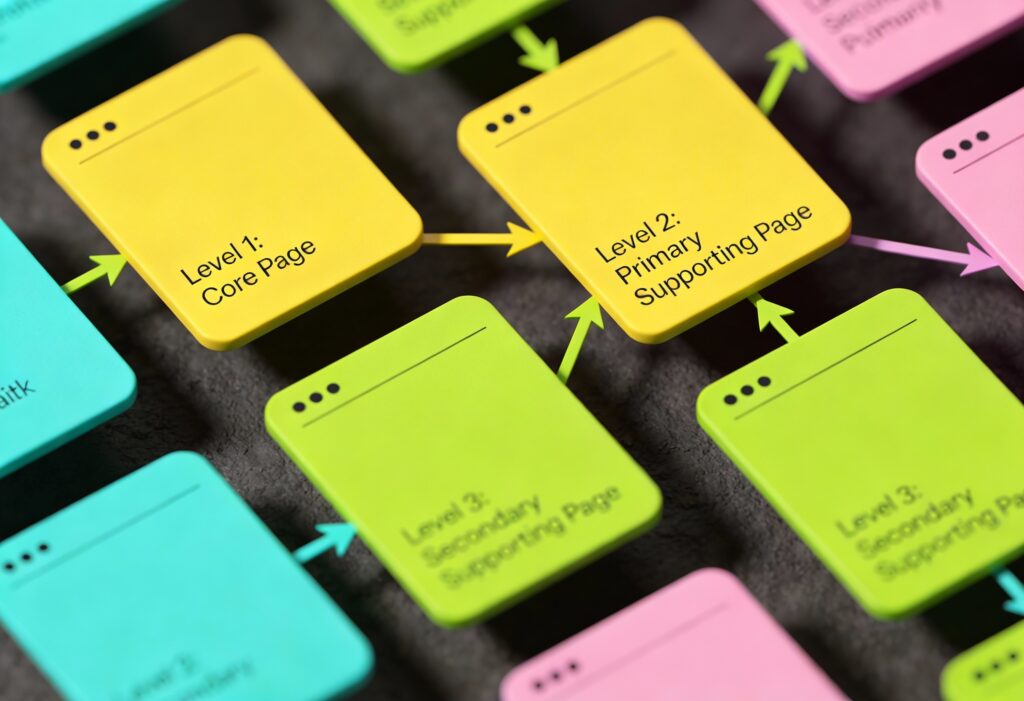
The hub and spoke model remains one of the most reliable frameworks for scalable internal linking. It mirrors how people explore topics and how search engines understand them.
A hub acts as a central resource on a broad topic. Spokes are supporting pages that explore subtopics in more detail.
Together, they form SEO content hubs that reinforce relevance and authority through consistent linking.
Choosing Core Hubs and Linking Priority Spokes
Not every page should be a hub. Choose hubs carefully based on business value, search demand, and topical depth.
Good hubs usually have these traits.
- They target broader search intent.
- They sit close to commercial or strategic goals.
- They can naturally link out to multiple related pages.
Once hubs are defined, identify priority spokes. These are pages that deserve visibility and support. Link from the hub to each spoke, and link back from spokes to the hub using descriptive anchor text.
This two-way linking clarifies relationships. It tells search engines that the hub provides the overview, while spokes add depth and specificity.
This structure also supports future growth. New spokes can be added without reworking the entire site, which helps internal linking scale over time.
Writing Descriptive, Consistent Anchor Text
Anchor text plays a bigger role internally than many teams realise. It acts as a label that explains what a linked page is about.
Avoid vague phrases. Words like “read more” or “learn here” add little value. Instead, use anchor text that reflects the topic and intent of the destination page.
Consistency matters. If one page is always linked using different phrasing, the signal becomes blurred. That does not mean repeating the same phrase mechanically, but the core topic should remain clear.
Internal anchor text also supports clarity when dealing with sensitive or complex link types. For example, if your site includes partnerships or monetised links, understanding how internal and external signals interact is essential. Use this guide on affiliate links and SEO best practices to learn how to manage this balance without undermining trust or rankings.
Strengthen Navigation and Context
Internal linking does not live only within blog content. Navigation systems and contextual cues play an equally important role in shaping how users and search engines understand your site.
Menus, breadcrumbs, and related links work together to form a clear hierarchy.
Using Related Links, Breadcrumbs, and Logical Hierarchies
Breadcrumbs show users where they are and how content fits within the wider website structure. They also reinforce hierarchy for search engines.
Related links, when chosen carefully, guide users to the next logical step. This could be a deeper article, a supporting guide, or a relevant service page. The key is relevance, not volume.
Logical hierarchies ensure that important pages are never buried too deep. Ideally, priority pages should be accessible within a few clicks from the homepage. This improves crawl depth and signals importance.
Strong internal linking also supports Sitelinks. When search engines clearly understand your site’s structure, they are more likely to surface meaningful Sitelinks in search results. These enhance visibility and trust while improving click-through rates.
Internal linking also intersects with broader decisions around link management. If you are weighing internal effort versus external support, take a look at this guide on whether to outsource SEO link building or keep it in-house.
Measure the Impact of Internal Linking
Internal linking should deliver measurable outcomes, not just theoretical improvements. Tracking the right signals helps validate decisions and refine your approach.
Measurement does not need to be complex, but it must be consistent.
Tracking Crawl Depth, Sitelinks, and Ranking Uplift
Start with crawl depth. Review how many clicks it takes to reach key pages. Over time, effective internal linking should reduce this number for priority content.
Monitor indexation and crawl frequency in search console tools. Pages that receive stronger internal links tend to be crawled more often and indexed more reliably.
Watch for ranking uplift. While internal linking alone may not drive dramatic jumps, it often supports steady improvements, especially for pages sitting just outside top positions.
Sitelinks are another useful indicator. When branded searches begin showing deeper or more relevant Sitelinks, it often reflects improved website structure and clearer link architecture.
Finally, review user behaviour. Improved internal linking often leads to longer sessions, lower bounce rates, and clearer conversion paths.
These outcomes confirm that internal linking is working for people, not just algorithms.
A Structure That Grows Stronger Over Time
Internal linking works best when treated as infrastructure, not decoration. It supports everything else you do, from content creation to conversion optimisation.
A thoughtful system based on hubs, spokes, and clear navigation creates a self-reinforcing ecosystem. Authority flows with intent. Pages support each other. Users find what they need without friction.
This is how internal linking compounds value. Not through shortcuts, but through clarity, consistency, and structure.
For teams that need structured SEO services and a clearer internal linking strategy, Yellowball provides practical, long-term solutions. Get in touch to discuss your project and get the ball rolling!