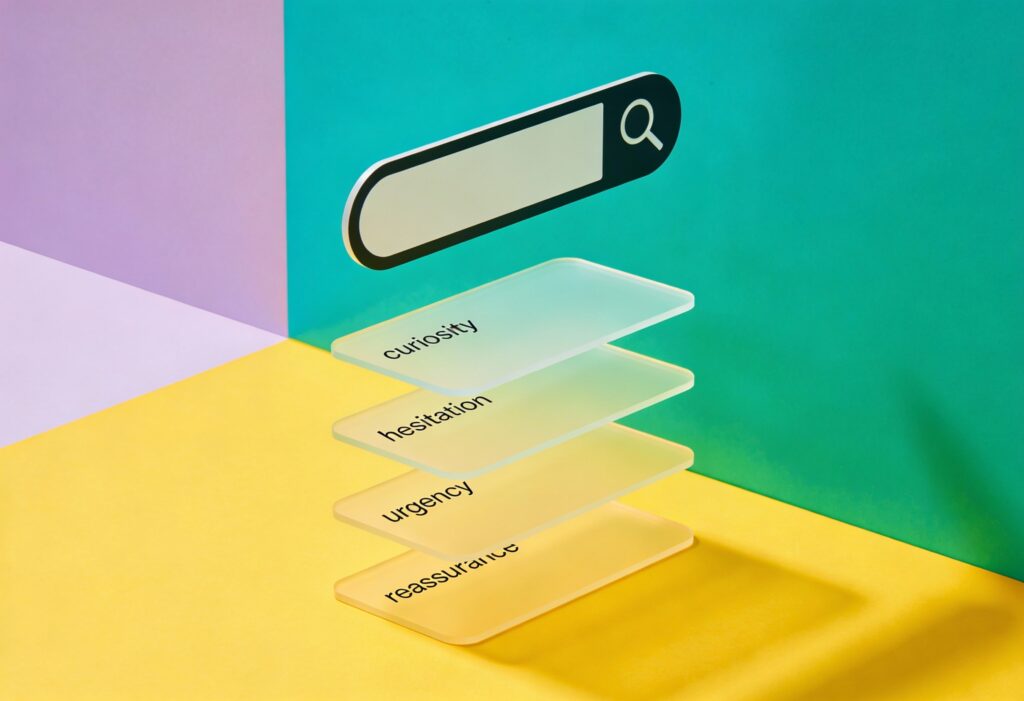
Every search carries context, even when it looks simple on the surface, and paying closer attention to the emotions that sit behind each query gives you a much clearer and more actionable picture of that journey. After all, people search while weighing options, feeling unsure, wanting reassurance, or wanting to make an immediate purchase. If you want your online advertising and e-commerce performance to really pay off this year, you need to respond to those moments with understanding and relevance instead of just targeting keywords.
Central to this change are search intent heatmaps, which reveal why users behave the way they do. They help marketers focus less on keywords and more on motivation. So, let’s look at what these heatmaps show, emotional intent signals, how AI identifies them, and how advertisers can shape creative that aligns with mindset, not just queries.
Why Search Intent Is Evolving Beyond Keywords
Search intent now extends beyond keywords because understanding motivation and emotional context is critical to predicting how and when people take action.
The Limits of Traditional Intent Categories
Traditional intent frameworks have relied on broad labels to explain search behaviour. Informational, navigational, and transactional categories still play a role, but they overlook the human element. A search for the same product can signal hesitation for one person and readiness for another. To understand search intent properly, advertisers must account for the emotions that drive how and when people act.
Why Emotional Context Now Drives Action
Decision-making is deeply influenced by emotion. Fear introduces delay, confidence creates momentum, curiosity encourages exploration, and urgency pushes decisions closer to action. Advertisers who account for emotional user intent can deliver experiences that feel helpful and human, which is especially valuable in e-commerce, healthcare, finance, and education sectors.
What Emotional Intent Heatmaps Reveal
Emotional intent heatmaps uncover how patterns of curiosity, hesitation, urgency, and reassurance shape the path from search to decision.
Mapping Curiosity, Urgency, Hesitation and Fear
Intent heatmaps reframe what heatmaps mean for modern search analysis. Rather than tracking on page interaction alone, they map behavioural cues across queries, sessions, and channels to highlight emotional patterns. Exploratory behaviour and long dwell times point to curiosity, rapid repeat visits suggest urgency, comparison loops signal hesitation, and risk-related language often indicates fear.
By mapping these patterns, teams gain clarity on how to understand search query intent beyond words alone, helping to improve user experience and better drive sales.
Identifying Mood Patterns Across Queries
Heatmaps reveal that emotions often follow predictable arcs. A user might start curious, move into hesitation, then look for reassurance from reviews or FAQs before converting. Another may arrive already urgent and skip the early stages entirely.
Recognising these mood patterns helps advertisers adjust messaging across channels. A first-touch ad can educate. A retargeting message can reassure. A landing page can remove friction at the right moment.
How AI Reads the Feelings Behind Search Behaviour
AI interprets search behaviour by analysing patterns in timing, language, and interaction to infer emotional states that influence decision-making. Here’s how it works.
Behavioural Clustering and Sentiment Signals
AI systems now process vast volumes of behavioural data to identify emotional signals at scale. They analyse timing, sequence, language nuance, device switching, and interaction depth.
These systems cluster users by behaviour rather than demographics. They identify patterns such as comparison loops, hesitation pauses, or rapid decision paths. This is where behavioural cues become actionable insight.
If you are asking yourself, “How can I use AI in marketing?”, this is one of the clearest answers. AI translates complex behaviour into practical targeting signals without relying on personal identifiers.
Predictive Emotion Modelling in Ads
Predictive models estimate likely emotional states based on behaviour history. This allows platforms to serve creative that align with consumer mindset rather than repeating the same message to everyone.
For instance, users showing hesitation may see reassurance-focused copy, social proof, or guarantees. Users showing urgency may see availability, speed, or limited-time messaging.
This approach respects user psychology while improving relevance.
Turning Emotional Insight Into Creative Strategy
Turning emotional insight into creative strategy means designing messages that respond to user mindset, not just the words they type.
Matching Ad Tone to Emotional State
Creative performance improves when tone matches mood. Calm language supports anxious users. Confident language supports decisive users. Educational language supports curious users.
This requires flexibility in creative development. Advertisers need multiple message variations designed around emotional states, not just product features.
Strong calls to action also matter. A hesitant user may respond better to “Learn more” than “Buy now.” A confident user may prefer clarity and speed.
Designing Messaging for Confidence, Reassurance or Urgency
Consider an e-commerce website example:
- Confidence-focused messaging highlights ease, speed, and choice.
- Reassurance-focused messaging highlights returns, reviews, and support.
- Urgency-focused messaging highlights availability and timelines without pressure.
Understanding what user intent is in e-commerce requires aligning these messages across ads, landing pages, and checkout experiences. Emotional mismatch creates friction. Alignment builds trust.
Applying Emotional Intent to Landing Pages and UX
Emotional intent does not stop at the ad click. If the landing page experience fails to reflect the user’s mindset, performance quickly breaks down. This is where many campaigns lose momentum. The message may feel right in the ad, but the page experience introduces friction, doubt, or confusion.
When curiosity drives the visit, pages should prioritise clarity and orientation. Clear headings, simple explanations, and visible pathways help users understand where they are and what to do next. For hesitant users, reassurance becomes critical. Trust signals such as reviews, guarantees, transparent pricing, and FAQs should appear early, not buried at the bottom of the page. For urgent users, speed and simplicity matter most. Fast load times, direct calls to action, and minimal distractions reduce delay.
Layout decisions also play a role. Dense pages increase cognitive effort, which can amplify anxiety or indecision. Clean spacing, predictable structure, and visual hierarchy help users feel in control. This is especially important in e-commerce, healthcare, and financial services, where emotional load is already high.
Intent heatmaps can guide these design choices. If behavioural data shows repeated comparison or backtracking, pages should surface answers sooner. If sessions are short and decisive, pages should remove unnecessary steps. UX becomes a response to emotion, not an abstract design exercise.
Targeting Strategies for 2026 Advertisers
Advertisers need to focus less on who users are and more on what they are feeling and ready for at that moment.
Segmenting by Emotion, Not Just Demographics
Demographics explain who someone is. Emotions explain what they need right now. Modern targeting blends both, with greater weight placed on motivation.
Emotion-based segments might include:
- Research-driven explorers
- Cautious comparers
- Ready to act buyers
- Reassurance seekers
These segments change quickly, sometimes within a single session. AI allows advertisers to respond in real time without manual rule-building.
Real Use Cases: From Retail to Healthcare
In retail, emotional targeting improves conversion by matching urgency and confidence. In healthcare, it builds trust by addressing fear and uncertainty. In professional services, it supports education before commitment.
Across industries, emotion-aware creative consistently outperforms generic messaging because it respects the human behind the query.
Measuring Performance of Emotion-Driven Campaigns
Measuring emotion-driven campaigns means looking beyond surface metrics to understand how trust, reassurance, and relevance influence real user behaviour over time.
Emotional Lift vs. Click-Through Metrics
Traditional metrics like click-through rate and cost per acquisition still matter. They no longer tell the full story.
Emotion-driven campaigns also measure emotional lift. This includes improved engagement depth, reduced bounce rates, faster decision cycles, and increased return visits. These signals indicate trust and relevance, not just clicks.
Identifying Creative That Resonates, Not Just Converts
Some creative builds confidence even if it does not convert immediately. That impact appears later in assisted conversions and branded search growth.
Intent heatmaps help teams identify which creative resonates at different emotional stages. This supports smarter budget allocation and long-term performance.
Stop Losing Conversions and Make Your Website Fly
Search intent heatmaps reflect a more profound shift in digital advertising and e-commerce websites. Performance now depends on empathy, not assumption. Brands that understand emotional intent respond with relevance and care. Those that rely on static keyword lists fall behind.
At Yellowball, this approach drives measurable results. Ballet with Isabella delivered a 313% ROI from organic search by aligning content with learner motivation. Chapel Bar lifted conversion rates by 63% in just three months through experience-focused optimisation. RSVP Call Centre recorded an 11,650% increase in top 10 keyword rankings by aligning intent with site structure. Applied grew page one keyword visibility by more than 5,200%, while Downing saw a 62% increase in non-branded enquiries by prioritising relevance and trust.
If you want your site and campaigns to respond to real human behaviour, not assumptions, it starts with strategy, speed, and experience. Want to make your strategy truly conversion-focused? Speak to the team at Yellowball, and let’s get the ball rolling!